✈️ Origins and the Comet Emblem
The 2nd Squadron of the Belgian Air Force traces its lineage back to 1913, making it one of the oldest units in Belgian military aviation. It was part of the 1st Group of the Aviation Militaire Belge, created just before World War I. The squadron adopted the “Comet” as its emblem — a symbol of speed, precision, and striking power — which remains its insignia to this day.
🪖 World War I Service
During World War I, the 2nd Squadron operated primarily in reconnaissance and artillery spotting roles. It flew aircraft such as the Henri Farman HF.3, Nieuport 10, Nieuport 17, and later the Nieuport 23, which were used by Belgian squadrons from 1917 onward. The unit played a vital role on the Western Front, supporting Belgian and Allied ground forces.
⚙️ Interwar Period
In the 1920s and 1930s, the squadron transitioned to more modern aircraft and continued its fighter and reconnaissance missions. It operated types such as the Avia BH-21 and Fairey Firefly. By the late 1930s, the squadron received the Gloster Gladiator Mk.I, a British-built biplane fighter delivered to Belgium starting in 1937.
🌍 World War II and Exile
At the outbreak of World War II in May 1940, the 2nd Squadron was part of Belgium’s air defense. Despite being quickly overwhelmed by the German invasion, several of its pilots escaped to the UK and joined the Royal Air Force, serving in units such as No. 349 (Belgian) Squadron and No. 350 (Belgian) Squadron, participating in the Battle of Britain and other Allied operations.
🚀 Post-war Jet Era
The squadron was re-established in 1947 as part of the 2nd Tactical Wing at Florennes Air Base. Over the decades, it operated several jet aircraft:
- Republic F-84F Thunderstreak (1955–1971)
- Dassault Mirage 5BA/BR (1970s–1980s)
- General Dynamics F-16 Fighting Falcon (1980s–2001)
From 1964 to 1966, the squadron was assigned NATO’s nuclear alert mission with the F-84F, supported by U.S. personnel. The 2nd Squadron was disbanded in 2001.
🛰️ Modern Era and Reactivation
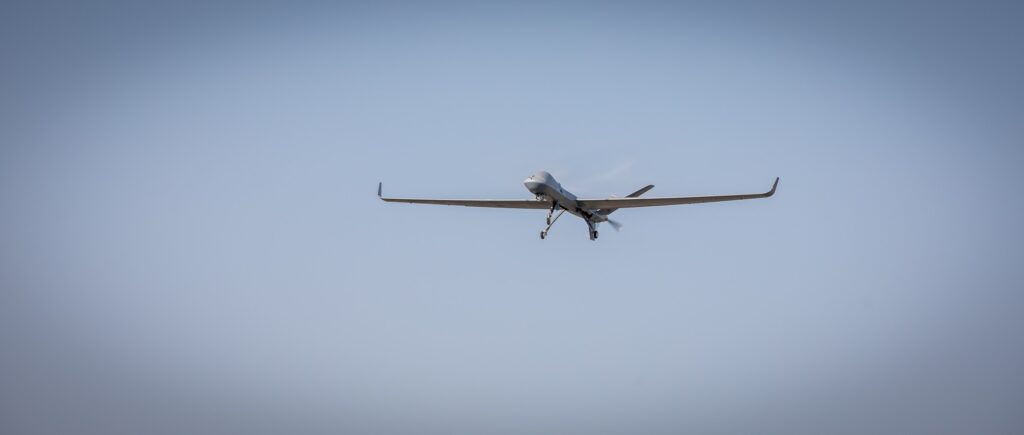
In line with the Belgian Air Force strategic shift towards unmanned aerial systems (UAS), the 2nd Squadron was reactivated in 2023 to operate the MQ-9B SkyGuardian, a state-of-the-art medium-altitude long-endurance (MALE) remotely piloted aircraft system (RPAS) developed by General Atomics.
This reactivation marks a new era for the 2SQN — from open-cockpit biplanes to high-tech unmanned aircraft. The squadron, now based at Florennes Air Base, plays a critical role in intelligence, surveillance, and reconnaissance (ISR) missions, both domestically and in support of NATO operations. In the near future, the 6 aircraft will be upgraded to allow the carriage of various weapons.
With its emblematic comet once again soaring in the skies, the 2nd Squadron embodies both the heritage and the future of Belgian military aviation.